Today’s lecture was held outside, in the lovely warmth and sunlight. We considered two ways to approach the following statement.
Claim. If  , then
  is free.
A Geometric Group Theory Proof
Instead of proving this claim directly, we started with a more general statement.
Theorem. If  freely and without edge inversions, then
  is free.
Proof. Let  be a tree, and consider an action
  such that the action is free and without edge inversions. Let
  be a fundamental domain of over this action.
If  , then this intersection must consist exactly of points
  such that is the midpoint of an edge. This follows from how we construct fundamental domains and the definition of a tree.
In particular, since trees have no cycles, the fundamental domain of a tree must consist of endpoints, edges, and half-edges. If endpoints or edges were shared between two fundamental domains, then would no longer be a partition . However, if contains a half-edge, then the other half of the half-edge must belong to some multiple  , again since we’re partitioning all of . If the midpoint of the edge belonged to one or neither, we wouldn’t be able to multiply any
  to obtain the midpoint, so the midpoint must belong to exactly two fundamental domains.
We want to use these midpoints to prove that is acting freely. To that end, we’ll seek to show that  generates a (free!) basis for . Symbolically, we want to show that for
![\[S = \{g \in G \ | \ \mathcal{F} \cap g\mathcal{F} \neq \emptyset\},\]](https://ggt.math.sites.carleton.edu/wp-content/ql-cache/quicklatex.com-de1b7b6369defbb869ee7a02f5099b32_l3.png "Rendered by QuickLaTeX.com")
that  .
.
Since acts freely on , we expect any for  that
that  , and by definition of a fundamental domain for an action, we expect for
  and
and  that
that  . Therefore every
  satisfies
  , and so contains all of .
We additionally seek to show that no freely-reduced non-trivial word  is trivial in . Toward that goal, consider some midpoint on our tree, an arbitrary
  . We may consider the path generated by “building up” to
  , or more precisely, the sequence of vertices generated by




With these midpoints on our tree in mind, we can consider the unique reduced path generated by connecting  to
to  , to
, to  , and so on. We’ll name these paths
  , and so on. Trees have pretty rigid structure; we can take advantage of this structure in order to make some pretty rigorous statements about each
  . Toward a contradiction, suppose that we have a loop, or more precisely that the same
  occurs more than once in the path from to
  . Since is a tree and thus contains no cycles, the loop implies we must have backtracked:
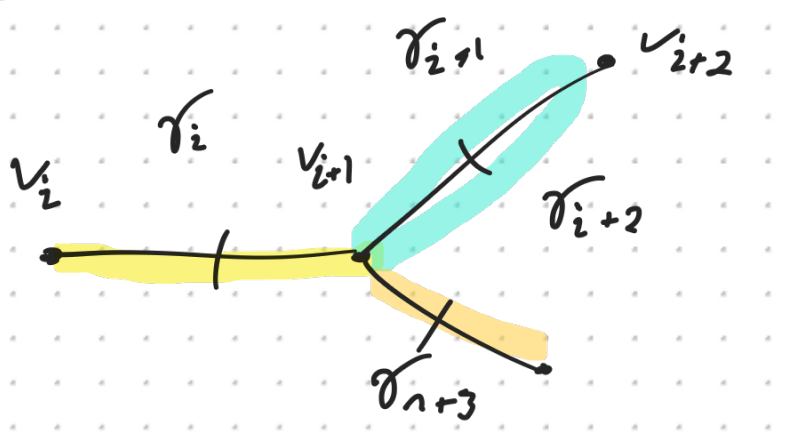
But we see that a backtrack implies that three separate fundamental domains all shared the same midpoint edge; this contradicts the definition of an edge midpoint. Instead, it must be the case that every non-trivial word in corresponds to a non-trivial action. Thus we know that freely-reduced non-trivial words in are non-trivial on , and so is indeed a basis of , and since our basis includes no relators, is free. 
Our original claim, that subgroups of free groups are themselves free, follows as a corollary. In particular, if is free and  , then and both act freely on the Cayley graph of . Since acts freely, is free. .
A Topological Proof
For the second part of the lecture, we considered a topological proof of our original claim that subgroups of free groups are free.
Definition. Given a space  and a point
  , a fundamental group
  is the group formed by the equivalence class of loops that start at
  over the operation of concatenation.
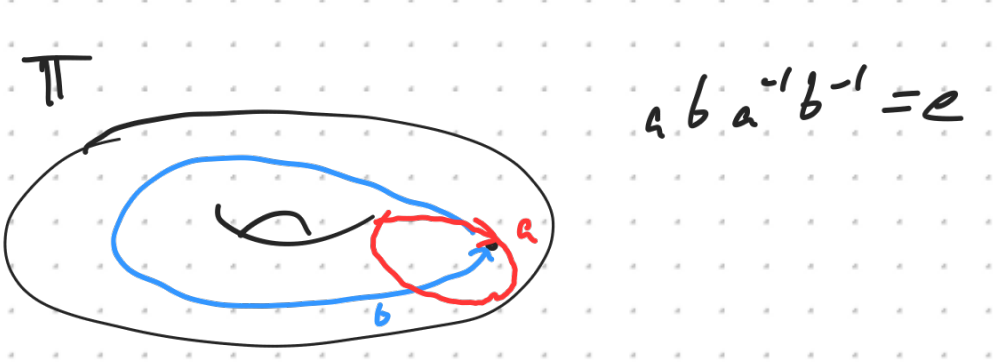
Example. Consider the torus  , and some point
  . We have (at least) two loops, one given by the vertical circle in red, and one given by the horizontal circle in blue:
Fact. For any graph  , it’s the case that
  is free.
I have very little background in topology, but I think this relates to the idea of thinking of free groups as little “bouquets” of loops. In some sense, I suspect this is what it means to be a free group.
Definition. Let and  be spaces, with a map
![\[f: Y \to X\]](https://ggt.math.sites.carleton.edu/wp-content/ql-cache/quicklatex.com-90681cb8a1e148d28e4550b7e0492f58_l3.png "Rendered by QuickLaTeX.com")
such that  is continuous, surjective, and locally homeomorphic. Then covers, or is a cover of, the space .
Fact. For some spaces  where is a cover of ,
  satisfies
  , and every
  corresponds to an open cover of . This property is known as Galois Correspondence.
We can use this assortment of facts and definitions to show that subgroups of free groups are free. For some , it’s the case that  . By Galois Correspondence, we know that any implies is a cover of , and so must be free.

Great post John! I liked the little ending bit on fundamental groups — I really like how (at least for some more tangible objects) you can almost compute the fundamental groups by looking at it. For example, if you take a disc, you can smush (I think the actual term is homotope) any loop into a point. However, my intuition immediately fails when looking at higher homotopy groups. Is there any point in trying to visual these? Or maybe we should just look at them algebraically?
Thanks! I can’t speak much to homotopy groups — I don’t have much experience using them. My sense is that past three dimensions, you can probably build an intuition for how these behave, but I don’t have that intuition and wouldn’t trust any result I couldn’t prove algebraically. I think about the way you can cheat with free groups and crunch everything into two dimensions; I wonder how true that is for more general spaces.