I’ll begin my second (!) blog post about free groups by recalling a proposition that cuts right to the heart of what a free group is.
Universal property. Let  be a generating set. Then
  is the unique froups os that for any
  gnerated by there exists a unique homomorphism
  such that the diagram below commutes.

This tells us that every group on some generating set is the surjected image of a free group, and hence we can think of the group as a quotient of that free group. This exactly what a group presentation is: in the set of relators we specify all the elements which normally generate (i.e. form a normally generated subgroup which is) the kernel of the map from  .
.
I’ll restate a puzzle which has to do with this fact: Prove that a group has a surjection to  if and only if has a presentation in which the sum of the exponents on every relator is
  . I won’t spoil the puzzle for anyone who’s working on it but for a slightly cryptic hint you can read the following sentence backwards: STNEMELE HCUS GNINIAMER EHT YB TUO DOM.
Next up we address the following postponed theorem:
Theorem: For free groups given by generating sets and  , we have
  if and only if
  .
.
The proof of this theorem relies on the observation that much of the difficulty in working with free groups comes from the lack of commutativity. A surprisingly effective way of dealing with this problem is to create an abelian quotient group by forcing elements which would be zero if the generators did commute into the kernel of a quotient map. To see this in rigorous terms we need a few definitions.
For elements  the element
 ![[a,b] := aba^{-1}b^{-1}](https://ggt.math.sites.carleton.edu/wp-content/ql-cache/quicklatex.com-d53509a1d1250548efd99d1cb45b385d_l3.png "Rendered by QuickLaTeX.com") is called a commutator. The subgroup of G generated by the set of commutators is called the commutator subgroup and is denoted
is called a commutator. The subgroup of G generated by the set of commutators is called the commutator subgroup and is denoted ![[G:G] \in G](https://ggt.math.sites.carleton.edu/wp-content/ql-cache/quicklatex.com-5ba2004fef28ce606670c968fa5c2898_l3.png "Rendered by QuickLaTeX.com") . To see that this subgroup is normal, let
. To see that this subgroup is normal, let ![c_1 \ldots c_n \in [G:G]](https://ggt.math.sites.carleton.edu/wp-content/ql-cache/quicklatex.com-373911dd1293c5a6f4a45792485abfe6_l3.png "Rendered by QuickLaTeX.com") , where the
, where the  are commutators. We must show that for all
  , we have
 ![g c_1 \ldots c_n g^{-1} = g c_1 g^{-1} g c_2 g^{-1} \ldots g c_n g^{-1} \in [G:G]](https://ggt.math.sites.carleton.edu/wp-content/ql-cache/quicklatex.com-b40816c00f5795d1508382f26f1a03b1_l3.png "Rendered by QuickLaTeX.com") . To do so we need only show
. To do so we need only show ![gc_ig^{-1} = g [a,b]g^{-1} \in [G:G]](https://ggt.math.sites.carleton.edu/wp-content/ql-cache/quicklatex.com-958683a7cbff91d3e1ab7fe4183c99a3_l3.png "Rendered by QuickLaTeX.com") which we can do by writing this element as a product of commutators:
which we can do by writing this element as a product of commutators: ![g [a,b]g^{-1} = [ga, b] [b, gb]](https://ggt.math.sites.carleton.edu/wp-content/ql-cache/quicklatex.com-ec0c821654043d0a16c11f38217da9f5_l3.png "Rendered by QuickLaTeX.com") . The resulting group
. The resulting group ![\overline{G} := G / [G:G]](https://ggt.math.sites.carleton.edu/wp-content/ql-cache/quicklatex.com-8519bd26cff8a587fdc672250e04dc8e_l3.png "Rendered by QuickLaTeX.com") is called the ablianization of , and it is, as its name suggests, abelian.
is called the ablianization of , and it is, as its name suggests, abelian.
We can now return to the question of settling the isomorphism classes of free groups. On the one hand, if  , there exists a bijection between and which can be used to induce an isomorphism
  . For the harder direction, we note that taking if , then their abelianizations must be isomorphic,
  , and those are much easier to understand. Namely,
![\[ \overline{F_S} = \mathbb{Z}^{|S|}. \]](https://ggt.math.sites.carleton.edu/wp-content/ql-cache/quicklatex.com-8bd5e733baa22010177caaa402f11a79_l3.png "Rendered by QuickLaTeX.com")
And hence we find that under our assumptions  . Which is only true if . We can illustrate this fact in the finite case by noting that
  contains an isomorphic copy of , the quotient with which is
  . Performing successive mods of these subgroups will reduce to the identity after exactly
  steps, a fact which uniquely identifies this group with the integer , and prevents it from being isomorphic to
  for
for  . The details are left to be sorted out.
We move now to the surprising fact that subgroups of finitely generated groups are not necessarily finitely generated. The proof is constructive, and it works by offering a subgroup of  which is not finitely generated, namely
![\[ S = \{ a^n b a^{-n} | n \in \mathbb{Z} \} \subseteq F_2. \]](https://ggt.math.sites.carleton.edu/wp-content/ql-cache/quicklatex.com-9cd21b51b92eb9fd02fc1a61406923a7_l3.png "Rendered by QuickLaTeX.com")
To see that  is not finitely generated, we must show that no freely reduced word in is the identity. Towards a contradiction, suppose that
![\[ s_1 \ldots s_n = e = (a^{k_1}b^{\pm 1}a^{-k_1})(a^{k_2}b^{\pm 1}a^{-k_2}) \ldots (a^{k_n}b^{\pm 1}a^{-k_n}). \]](https://ggt.math.sites.carleton.edu/wp-content/ql-cache/quicklatex.com-39a07b9bf44980dc534105789452ffb3_l3.png "Rendered by QuickLaTeX.com")
For the above to be true, there must be some sequence of cancellations that reduces the right hand expression to the identity, which means there is a pair of  and
and  which are immediately adjacent except for the powers of
  which cancel with each other, and hence must be part of an expression of the form
  which in turn looks like
  in the original word, meaning that it was not freely reduced with respect to our generating set, contradicting our assumption that there is such a freely reduced word which equals the identity. We have shown that
  , which is the free group on countably many generators.
We only need to modify this argument slightly to conclude that has subgroups isomorphic to  for every integer . Indeed take the generating set
  .
.
To contrast with this surprising fact, we note that every quotient group of is finitely generated, since we can use the image of its generators under the natural surjection  , where the same idea holds in any finitely generated group. In practice this looks like using the “same” generators for the quotient group.
Since we’ve started down the path of analyzing subgroups of , and I’ve mentioned a surprising fact followed but an underwhelming fact, I’ll conclude the post by mentioning a surprising plan of attack on a somewhat reasonable fact. In choosing a subgroup of the free group , we have the freedom to choose its generators, but not to introduce any relators, this makes it seem that the resulting group, whatever the cardinality of a minimal generating set happens to be, should probably be free.
Theorem: If  then
then  is a free group.
This fact is true, but the proof is surprisingly difficult, it turns out that the key idea is to use a seemingly more difficult theorem that invokes the geometric structure of and its actions.
Theorem: A group  acts freely on a tree without edge inversions if and only if that group is free.
The proof of the first theorem now becomes simple. We simply state that acts on the tree  (without edge inversion), and therefore each of its subgroups act on , and indeed by the above theorem this makes free.
This is a beautiful result of the Cayley graph machinery we’ve seen so far. It raises another question about what it means when we find  , but the graph
  has degree four at every vertex whereas the the graph
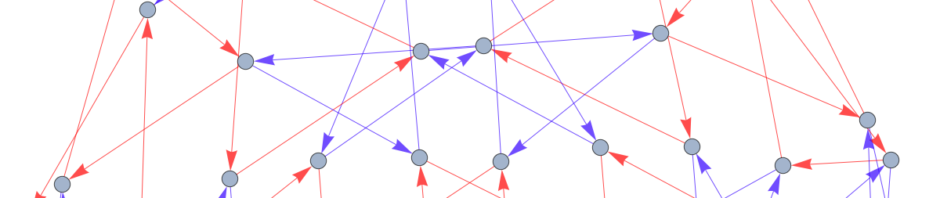
  has degree six at every vertex. There certainly can’t be such a tree contained as a sub-tree of , but we do have a geometric object which is essentially a disjoint union of paths which we can treat as such a “sub-tree.” An illustration of this tree in red and orange is given below.
We take the subgroup generators  .
.

Here we can imagine that the tendrils drawn in blue are symmetrically extending in an identical manner at each vertex at the ends of the blue baths. The symmetries of this set of paths are exactly the symmetries of the tree of degree  .
.

Nice post, Horace!
I first have a comment on your puzzle since I would like to elaborate on the solution a bit more. Let me remind everyone of the problem: Prove that a group G has a surjection to \mathbb{Z} if and only if G has a presentation in which the sum of the exponents on every relator is 0.
Going back to the universal property of free groups, then, there is a surjection from
from  to
to  if and only if the concatenated diagram (gluing the surjection of
  to
to  at the bottom of Horace’s diagram) is commutative. We would like to get the information about the kernel
  to say the information about the relators. Indeed, we note that
  , where
  is a map from
  to
to  so that all but one generators are in the kernel. Backtrack a bit, since
  has to send all generators of
  to 1, the map
  needs to have the kernel of all relators summing up to 0 to make the map compatible (in other words, canceling all generators but one).
Nice post, Horace!
I first have a comment on your puzzle since I would like to elaborate on the solution a bit more. Let me remind everyone of the problem: Prove that a group G has a surjection to \mathbb{Z} if and only if G has a presentation in which the sum of the exponents on every relator is 0.
Going back to the universal property of free groups, then, there is a surjection from
from  to
to  if and only if the concatenated diagram (gluing the surjection of
  to
to  at the bottom of Horace’s diagram) is commutative. We would like to get the information about the kernel
  to say the information about the relators. Indeed, we note that
  , where
  is a map from
  to
to  so that all but one generators are in the kernel. Backtrack a bit, since
  has to send all generators of
  to 1, the map
  needs to have the kernel of all relators summing up to 0 to make the map compatible (in other words, canceling all generators but one).
Free groups (and infinite groups more generally) really make one question what it means for groups to be “smaller” than other groups. For example, we can think of as being “one-fifth” of
  . Even though both are infinite, we can fit five copies of the subgroup in the larger group. However, this flies out the window with free groups since
  for any
  . Using the same logic as before, this would imply that
  is both smaller than and larger than
  , which appears to be a contradiction. I wonder how many cosets
  has in
  and if that might help me wrap my head around this.
Great post Horace! One thing I wonder about is whether there are free subgroups of non-free groups. Is it a requirement for a group to be free and have free subgroups or do things get more complicated? Could we also use the free subgroup theorem for this?
I think things get more complicated; isn’t a free group, but it’s got
  as a subgroup, which is free.
(We also see this in light of more recent developments in class about free products!)