Monday’s class brought us back to a claim we made last Wednesday, before our fun Coxeter group excursion. MurphyKate noted that this problem showcased a few things: notably free groups being sneaky and hiding in places we might not expect, ‘peak geometric group theory’, and mathematicians’ eternal inability to name things properly.
With that, let’s get started!
Claim : Let  , and let
  generated by
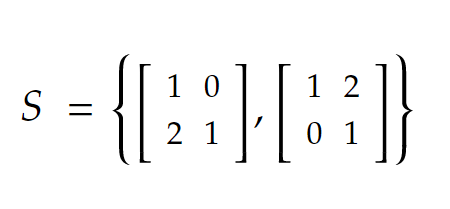
We claim that 
How do we go about this? The tricky part about showing that our  is a basis for
  comes in the second clause for a basis: that no nontrivial word in our basis will be trivial in the group.
We take a geometric approach! Seeing as  is a subgroup of a linear group, we look at the action of on
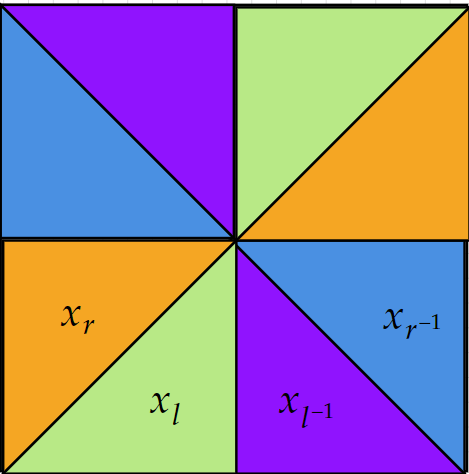
  through linear transformations. Let’s subdivide our plane into 4 sections with the lines
  and
and  and see how each element of moves these sections. Note that these sections are open!
To make this easier, let’s calculate what our elements do a given vector
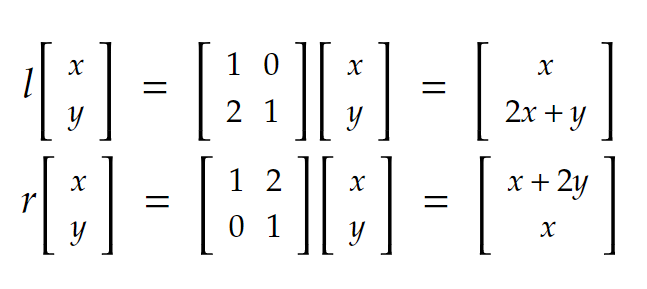
With these, we can start to fill in our picture. Let’s look at what happens under the action of  .
.
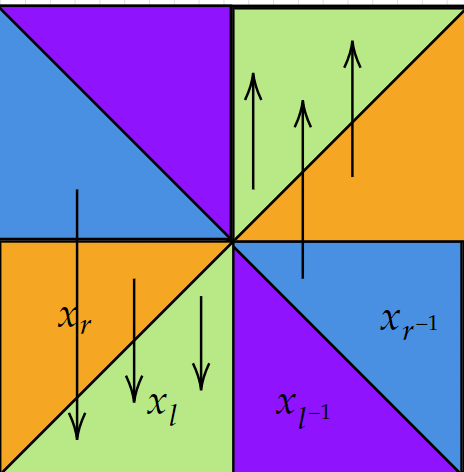
Note that everything gets pushed into the section we’re calling  . Everything except for
  , that is! Weird things happen with that section, and I’d encourage you guys to play around with random vectors in that section. Horace mentioned in class that it’s a good idea to look at the boundaries of our sections — this leads us to see that one boundary for
  is fixed (the one that is along the x-axis), and our other one goes to
  , which means that our new boundaries encapsulate many sections of our plane. Anyways, I think it is fine to not completely understand what happens with vectors in that area, as it is not integral to our proof. In fact, the much more important part is that every other section gets mapped into !
This is not a coincidence! We can fill out a table that captures all motion under our generators.
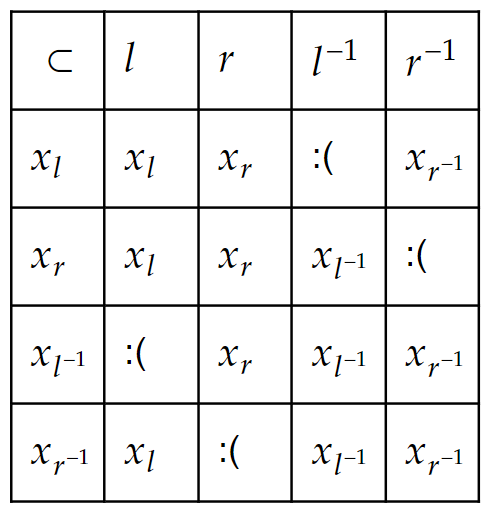
The main idea from this table is that  , for some
  in our generating set, as long as
  .
.
It’s here where the value of looking at these as actions comes in. We want to show that any nontrivial freely reduced word in our basis is nontrivial in our group too, so this is equivalent to asking whether or not our nontrivial freely reduced word actually moved nothing.
Well, let’s look at such a word  . Let’s now pick a section of our plane for our word to act on. Since we’re given the choice, it’s important that we don’t pick our one ugly choice — that being
  , as that’s the choice that messes everything up.
This gives us

With our handy table we see that, our point is now contained completely in 

We repeat this process

Note that we avoid the ugly case of two consecutive elements being inverses, as that would imply that our word was not freely reduced! Sweet! If we follow this process to completion we get that

Here’s where the containment not being strict is helpful — it guarantees that something is moved! So our w is nontrivial and H really is isomorphic to !
That slick containment strategy was actually an application of the Ping Pong Lemma, which MurphyKate calls ‘peak geometric group theory’. It’s exploiting the action of a group and observing geometrically how it acts on that space to tell us something about the group itself! The Ping Pong Lemma as stated in class (it’s a little different in our book) is as follows:
Let  . If there exists disjoint open regions such that
  for all
  , then
  is free.
This example was also especially powerful because it showed how free groups hide in some other groups. Very sneaky. Our good friend Jacques Tits also thought this was sneaky of them so he got angry and looked for more of these hidden free subgroups and proved the Tits Alternative. It states that every finitely generated linear group either has a free subgroup, or is virtually solvable. As I was in the process of writing this blog post, I realized that everyone in the class has had some experience with Galois Theory, so you guys will recall that a solvable group is one that has a derived series ending in the trivial group.
A derived series is a series of subgroups such that each consecutive subgroup is the commutator subgroup. Let’s look at the derived series of  .
.

This series terminates in the trivial group so is solvable.
This is really crazy to me! It characterizes such a wide variety of groups!
We were actually supposed to see some more applications of the Ping Pong Lemma, but those were postponed to our next class. So stay tuned for next class where we’ll use the Ping Pong Lemma to discover the meaning of life and to solve all of our problems. Thank you for reading!

Very great post! I love your crystal-clear pictures. does on any region of the plane rather than the one labeled as
  , it would be more helpful to think about how crazy the group action is on the
  region. Recall that there are two essential features of a free group: 1) different generators have no relations at all. 2) for a fixed generator, the inverse is independent because any generator has infinite order.
Here is my way of thinking about the ping-pong Lemma. Rather than thinking about how regular and predictable a group action of
Therefore, in constructing the Ping Pong Lemma, we first note that different actions have different plane distortions. Secondly, and more importantly, there is a region in the plane that does crazy things upon actions. Such crazy behavior manifests the independence of the inverse. Also, the continuity of all the linear transformations would then force other parts of the plane to behave nicely as a consequence. Although this argument is super heuristic, I hope it will help understand the mystery of Ping Pong Lemma a bit better.
Hi Shuhang,
I really, really appreciated this — I really like having a bigger and more intuitionistic picture before I try to work with a concept, so your explanation was very helpful! I feel more ready to do the homework now 🙂
As I’ve thought more about the Ping-Pong Lemma, I have found more and more interesting the fact that all but one region maps to the same single region (e.g. ,
,  , and
, and  all map to
  under
under  ). However, since this is matrix multiplication and our matrices have determinant 1, they are invertible, so the group action is also invertible. Therefore, the three mappings are overlaying on each other and perfectly fit together to cover the region without overlapping.
Amazing post Akash!!
I really like how you explain the Ping Pong Lemma, it makes a lot more sense after reading this post. Also, I like what you say about solvable groups. Remembering lots of Galois theory now 🙂
I also see now the difference between solvable and free groups!
Thanks!