Today, we had an exciting guest lecture by Dr. Kasia Jankiewicz, a professor at the University of California, Santa Cruz. Dr. Jankiewicz discussed reflections, which give us a geometric interpretation for elements of certain groups. For instance, (at least) half of the elements of the dihedral group of order  can be interpreted as reflections of the regular
  -gon. Below is a summary of the topics Dr. Jankiewicz discussed.
Consider a reflection  across a line
  in
in  :
:
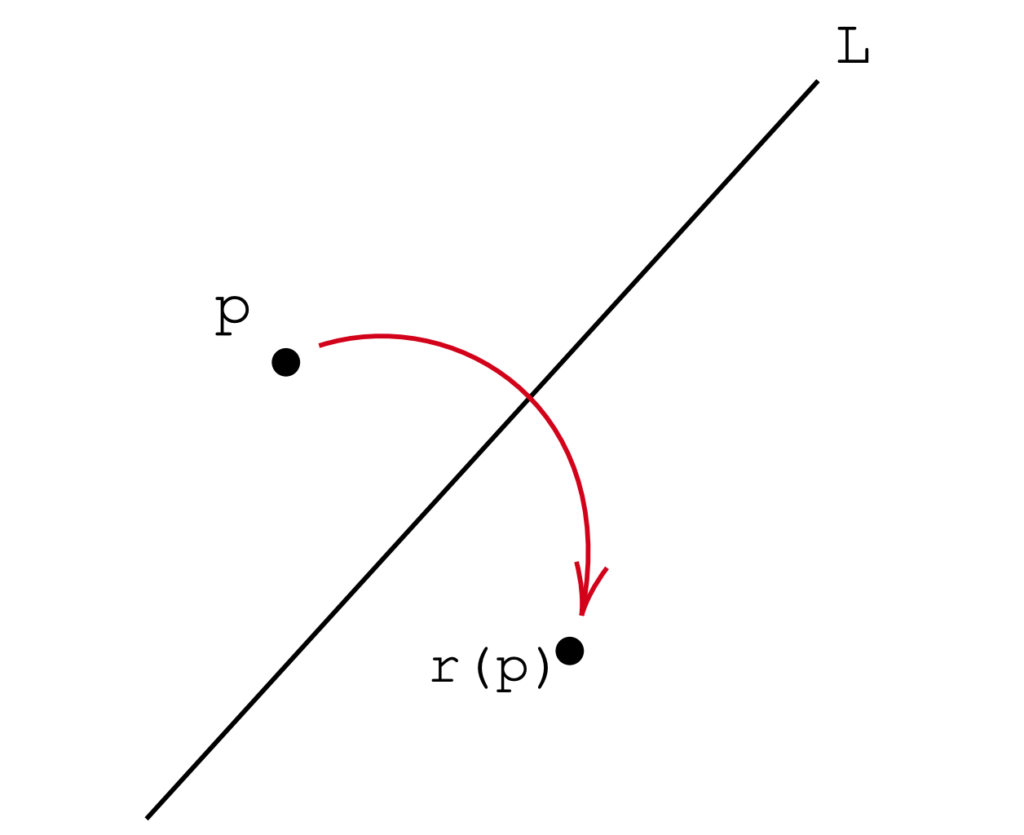
Such a reflection brings a point  to a point
  on the other side of .
Similarly, in  we can consider a reflection over a plane
  :
:
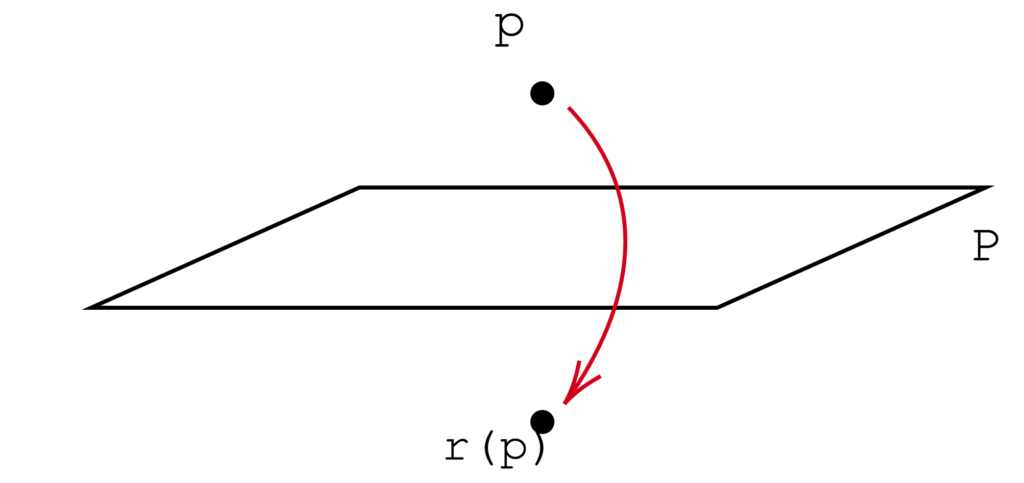
More generally, in  there exists a reflection across any copy of
  . Our goal for today is to look at groups generated by reflections.
Consider a regular pentagon on the plane. Let and  be reflections across the lines
  and
and  which intersect at angle
  .
.

How do each of these reflections permute the vertices  ?
?
 ,
,  ⟷
⟷  ,
,  ⟷
⟷  .
.
 ,
, ⟷ ,  ⟷ .
⟷ .
What does  do?
do?
 ⟶ ⟶ ⟶ ⟶ ⟶ …
Therefore, is a rotation by  about the center of the pentagon. Because we know and generate
  , we can conclude that and generate as well, giving us the the group presentation:
![\[ D_{10} = \langle r,s | r^2 = s^2 = (rs)^5 = e \rangle \]](https://ggt.math.sites.carleton.edu/wp-content/ql-cache/quicklatex.com-7f29318c8ffe8fd05f85034d5a8b4763_l3.png "Rendered by QuickLaTeX.com")
We can generalize the above conclusions. If and are reflections about lines intersecting at the angle  , then is a rotation about the intersecting point by angle
  .
.
Let’s look at another group generated by reflections. Consider the real line. Let denote the reflection across  , and denote the reflection across
  .
.
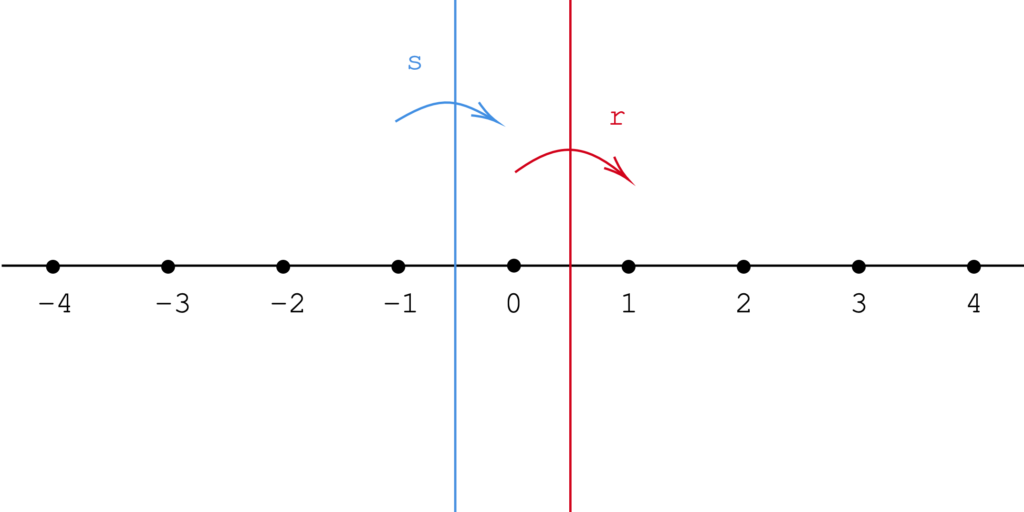
How do these reflections transform points on the line?
 ⟷
⟷  ,
,  ⟷
⟷  ,
,  ⟷
⟷  ,…
,…
 ⟷ , ⟷ , ⟷
  ,…
,…
In general,  and
and  . Composing and yields a translation across the real line:
![\[ rs(x) = 1-(-1-x) = x+2\]](https://ggt.math.sites.carleton.edu/wp-content/ql-cache/quicklatex.com-34f477afc85f8bff9c3c619ab0191482_l3.png "Rendered by QuickLaTeX.com")
In general, if and are reflections about non-intersecting lines and at distance  from each other, then is a translation by distance
  orthogonal to those lines. We call the group generated by two such reflections the infinite dihedral group, denoted
![\[D_{\infty} = \langle r,s | r^2 = s^2 = e \rangle \]](https://ggt.math.sites.carleton.edu/wp-content/ql-cache/quicklatex.com-0091c56dee0beb90c464e8e7c2904b30_l3.png "Rendered by QuickLaTeX.com")
Note that the direction in which shifts points on the line depends on the relative positions of and . If lies to the right of , then  lies to the right of
  .
.
Now, let’s look at an example of a group generated by reflections in . Consider the cube with corners  . Let , , and
  be reflections across the planes
  ,
,  , and
, and  respectively.
The planes and intersect at angle  , so is a rotation about the -axis by angle
  . This yields the following presentation of the group of symmetries of a cube:
![\[ \langle r, s, t | r^2 = s^2 = t^2 = (rs)^2 = (st)^2 = (tr)^2 \rangle \]](https://ggt.math.sites.carleton.edu/wp-content/ql-cache/quicklatex.com-161c73244696617eab989c86292950d5_l3.png "Rendered by QuickLaTeX.com")
Note that, given the above abstract presentation alone, you may not be able to distinguish between generators that change the orientation of the cube and ones that preserve it.
Now, let’s consider another infinite group generated by reflections. Consider an equilateral triangle in and reflections about the lines bordering its edges. We’ll say that three edges corresponding to the reflections , , and are colored red, blue, and green respectively. In the drawing below, the red, green, and blue edges lie along red, green, and blue lines:
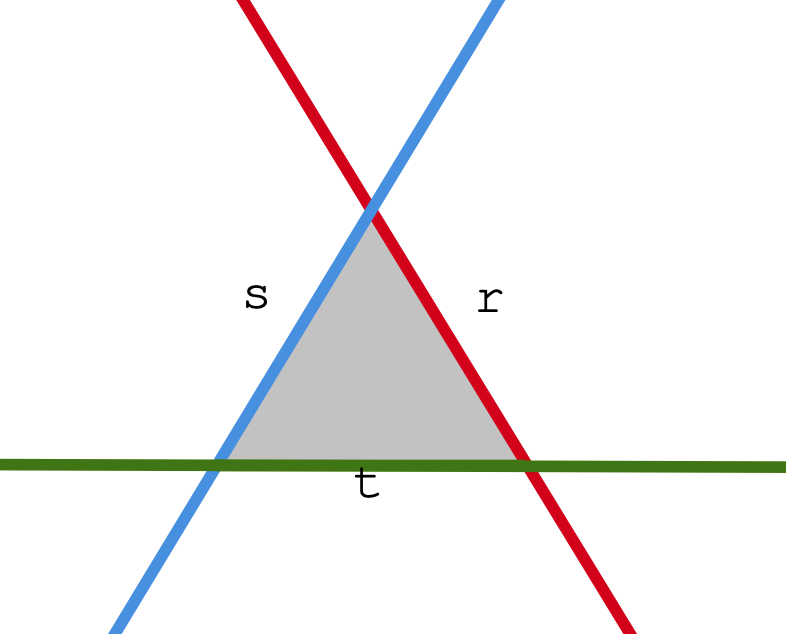
The angle between the red and blue lines is  , so
, so  . When we perform a reflection along one edge, observe that the lines along which the other edges lie are rotated. The transformations of the equilateral triangle yielded by flipping along edges can form a group. For instance, if we consider the group generated by flipping across the edges and , we get six triangles forming a hexagon:

However, the group generated by , , and together gives a tessellation of the plane with equilateral triangles, yielding the following presentation:
![\[ \langle r, s, t | r^2 = s^2 = t^2 = (rs)^3 = (st)^3 = (tr)^3 \rangle \]](https://ggt.math.sites.carleton.edu/wp-content/ql-cache/quicklatex.com-8c1fbdc31286f485469d9d84fe030859_l3.png "Rendered by QuickLaTeX.com")

For a more detailed treatment of the above group, see chapter 2 of John Meier’s Groups, Graphs, and Trees. This group is an example of a triangle group, a group generated by reflections of a triangle across its edges. It is also an example of a Coxeter group!
Definition: A Coxeter group  is a group with a presentation of the form:
![\[W = \langle s_1, s_2, ..., s_n | s_i^2, (s_i s_j)^{m_{i,j}} \rangle \]](https://ggt.math.sites.carleton.edu/wp-content/ql-cache/quicklatex.com-c49def406731559664bb524c23b61cbf_l3.png "Rendered by QuickLaTeX.com")
where  . If we say
  , we mean that there is no relation of the form
  for
for  .
.
If you’re interested in learning more about the abstract geometric constructions described by Coxeter groups, see buildings, Coxeter complexes, the Davis complex, or Tits representations.
Here are a couple more neat facts that we briefly touched on regarding Coxeter groups:
- All the data in a Coxeter group can be encoded in a labelled graph, whose vertices correspond to generators and whose edges are labelled by the finite
 s. In other words, if
  is a relation in the presentation of a Coxeter group, there is an edge of weight between
  and
and  . Note that, because
  for all
  , we don’t need to orient the edges of this graph.
 - Coxeter groups are linear, meaning any Coxeter group is isomorphic to a group of invertible matrices under matrix multiplication. It is not immediately apparent to me why this is the case, but it seems pretty neat.

Beautiful post Sam! The pictures are so clean and appealing to the eye; they make me hungry. To add on to your list of further reading resources, I emailed Dr. Jankiewicz and she gave me these resources (ordered roughly by ease of readability)
Some notes by Thomas
https://mathstats.uncg.edu/number-theory/wp-content/uploads/sites/6/2019/06/Ann-Thomas_2016_Geometric-and-topological-aspects-of-Coxeter-groups-and-buildings-lecturenotes.pdf
Slides from Davis
https://people.math.osu.edu/davis.12/talks/handout.pdf
A detailed book by Davis
https://people.math.osu.edu/davis.12/davisbook.pdf